
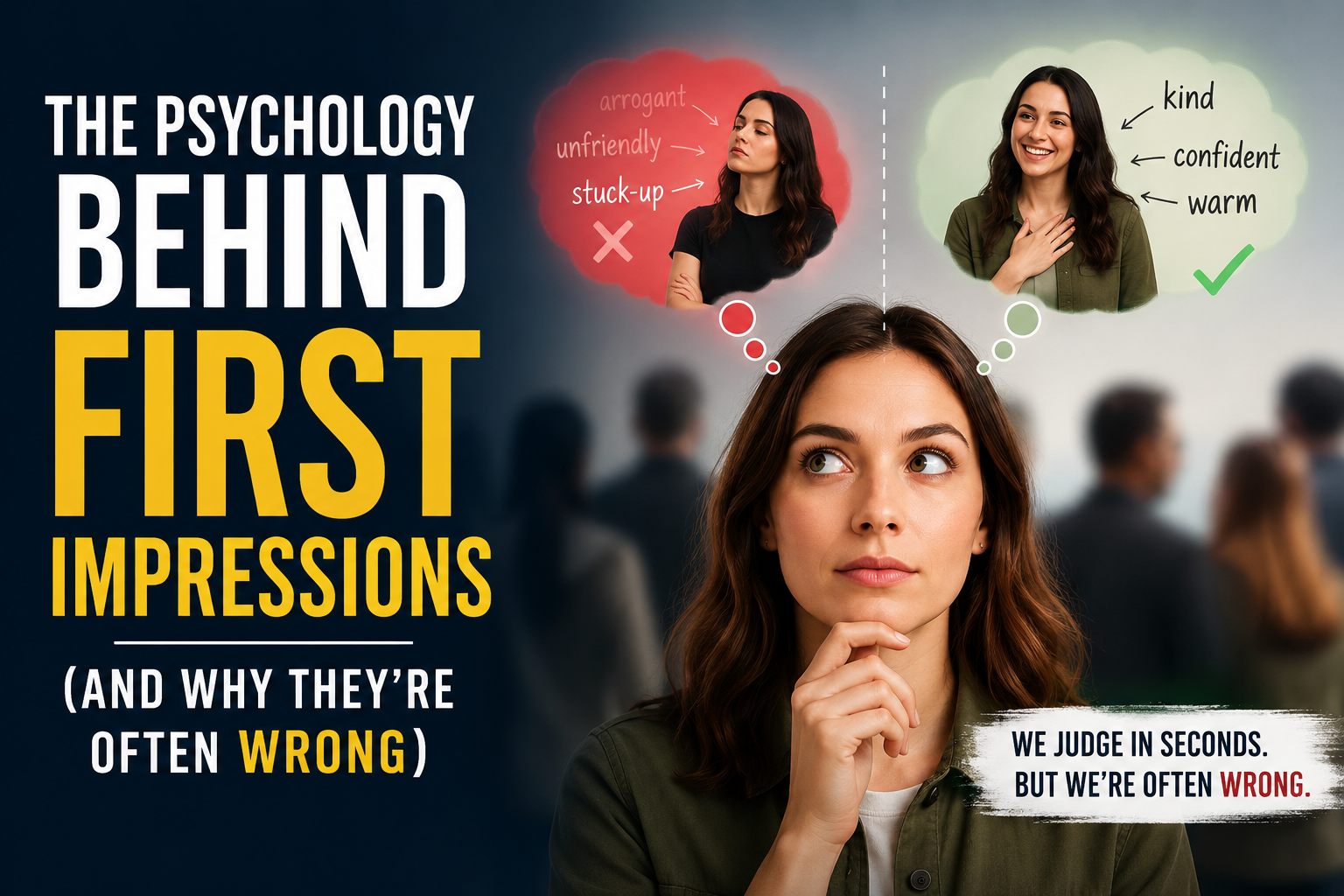
Imagine meeting someone for the first time. Within moments, you’ve already formed an opinion. They seem friendly, confident, arrogant, trustworthy, or perhaps a little intimidating. The strange part is that they may not have said more than a few words.
Whether we realize it or not, our brains are constantly making rapid judgments about the people around us. These first impressions happen almost automatically, shaping how we treat others and how we expect them to behave. While this ability once helped our ancestors quickly identify potential friends or threats, it isn’t nearly as reliable in modern life as we’d like to believe.
The truth is that first impressions often tell us more about our own brains than they do about the person standing in front of us.
Why We Judge People So Quickly
The human brain processes an incredible amount of information every second. If we carefully analyzed every person we met, even simple social interactions would become mentally exhausting. Instead, our minds rely on shortcuts to make fast decisions.
As soon as we see someone, our brains begin collecting clues. Their facial expression, clothing, posture, voice, and even the way they walk are processed almost instantly. Without conscious effort, we combine these observations into a story about who that person might be.
This process feels logical because it happens so effortlessly. Unfortunately, speed often comes at the cost of accuracy.
Imagine someone arriving late to a meeting looking stressed and avoiding eye contact. It’s easy to assume they’re rude or uninterested. In reality, they may have been dealing with an emergency or simply be anxious in unfamiliar situations. Our brains fill in the missing pieces long before we have enough evidence to understand what’s actually happening.
The Halo Effect: One Good Trait Changes Everything
Psychologists have identified dozens of cognitive biases that influence our thinking, and one of the most powerful is known as the Halo Effect.
The Halo Effect occurs when one positive quality influences how we perceive everything else about a person. If someone appears attractive, speaks confidently, or dresses professionally, we often assume they possess other positive qualities as well. They seem more intelligent, more capable, and even more trustworthy, despite having no evidence for those conclusions.
The opposite is equally true. One awkward moment or an unusual characteristic can create a negative impression that colours everything else we notice.
This explains why two people can witness the exact same interaction and walk away with completely different opinions. They’re not seeing the person objectively, they’re seeing them through the lens of their own first impression.
Why It’s So Difficult to Change Our Minds
Once we form an opinion about someone, our brains become surprisingly protective of it.
This is partly because of confirmation bias, our tendency to notice information that supports our existing beliefs while ignoring evidence that contradicts them.
Suppose your first impression is that a colleague is unfriendly because they barely spoke on your first day at work. Over the following weeks, you’ll probably notice every quiet moment while overlooking the times they’re kind, helpful, or smiling at others. Without realizing it, you’re collecting evidence to support the conclusion you’ve already reached.
Changing our minds requires effort, and our brains naturally prefer consistency over uncertainty.
Appearance Isn’t Character
We often believe we’re good judges of character, but appearance can be remarkably deceptive.
A confident speaker may actually struggle with self-doubt. Someone who seems distant might simply be shy. A person covered in tattoos may be gentle and compassionate, while someone dressed in expensive clothes may not be as successful as they appear.
Humans are experts at creating stories from very limited information. The problem is that these stories often feel like facts.
Social media has made this tendency even stronger. We regularly form opinions based on profile pictures, carefully selected photos, and short biographies. Yet online identities are curated versions of reality, showing only the moments people choose to share.
Judging someone from a social media profile is a little like judging a book after reading only the cover.
The Power of the Primacy Effect
Another psychological phenomenon known as the Primacy Effect helps explain why first impressions are so persistent.
Information we receive first tends to have a greater influence on our memory than information that comes later. If your first interaction with someone is awkward, your brain gives that experience extra weight. Even after dozens of positive encounters, that original impression can continue influencing how you interpret their behaviour.
This is why people often say, “You never get a second chance to make a first impression.”
While that’s true to some extent, it also reminds us how unfair our brains can be. One bad day, one nervous conversation, or one misunderstanding can shape how someone is perceived for months or even years.
Culture Shapes Our Judgments Too
Not every first impression is based on universal human behaviour. Culture plays a significant role in how we interpret the actions of others.
In some cultures, direct eye contact signals honesty and confidence. In others, it can be viewed as disrespectful or overly aggressive. Speaking loudly may suggest enthusiasm in one country and rudeness in another. Even something as simple as personal space varies dramatically around the world.
Without understanding these differences, we can easily mistake unfamiliar behaviour for negative personality traits.
Learning to Slow Down
Although first impressions are automatic, we don’t have to accept them as the final verdict.
One of the most valuable habits we can develop is curiosity. Instead of assuming we understand someone after a brief interaction, we can ask questions, remain open-minded, and allow our opinions to evolve over time.
The people who initially seem quiet may turn out to be thoughtful listeners. Those who appear confident might be hiding insecurities. Someone who makes an awkward first impression may eventually become a trusted friend.
People are far more complex than the stories our brains invent in the first few seconds.
Final Thoughts
First impressions are one of the brain’s greatest shortcuts. They help us navigate social situations quickly, but they also remind us that the mind is far from perfect. We naturally search for patterns, make assumptions, and create narratives from incomplete information.
The next time you catch yourself instantly judging someone, pause for a moment. Ask yourself whether you’re seeing the person as they truly are, or simply seeing the story your brain has written about them.
More often than not, the most interesting people are the ones who completely change our first impression.
At Anonymous Minds, we believe understanding psychology isn’t just about learning how the brain works, it’s about learning how to think a little more carefully, question our assumptions, and see both ourselves and others with greater clarity.


