
Have you ever found yourself in an argument where no amount of evidence seemed capable of changing the other person’s mind? Maybe you’ve experienced the opposite. You were convinced you were right, only to discover later that you had ignored important facts all along.
It is easy to assume that humans make decisions based on logic and reason. After all, we like to think we carefully weigh the evidence before reaching a conclusion. Psychology tells a very different story. Much of our thinking is influenced by hidden mental shortcuts that operate automatically, often without our awareness.
These shortcuts are known as cognitive biases, and they affect every person on the planet. While there are dozens of well-studied biases, psychologists consider one to be especially influential because it quietly shapes the way we see the world every single day.
It is called confirmation bias.
What Is Confirmation Bias?
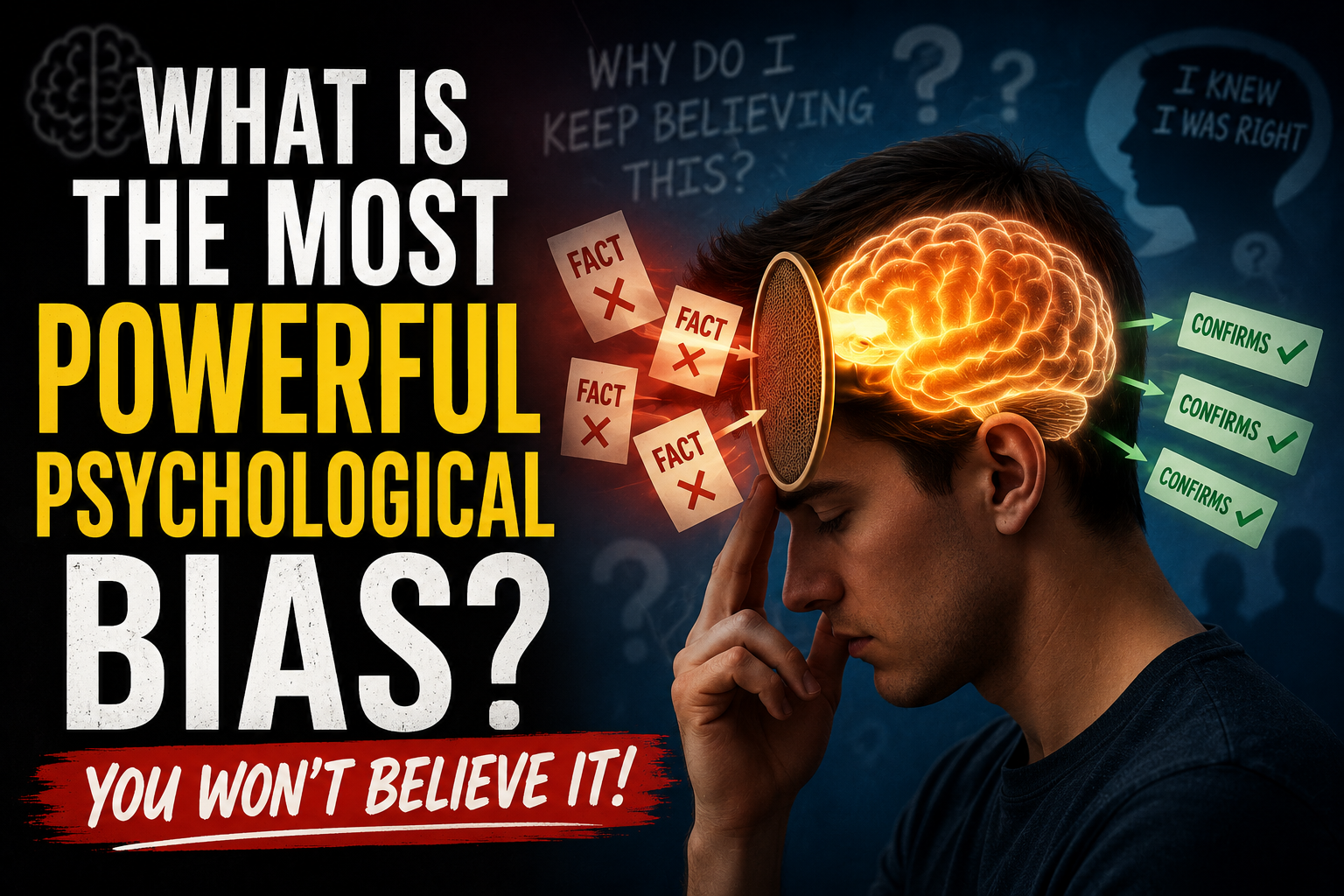
Confirmation bias is our tendency to seek out information that supports our existing beliefs while ignoring, dismissing, or forgetting information that challenges them.
At first, this may sound like something that only affects stubborn people. In reality, it affects everyone. It does not matter how intelligent, educated, or experienced you are. Your brain naturally prefers information that feels familiar because it requires less mental effort.
Think about the last time you searched online for advice. Were you genuinely looking for different perspectives, or were you hoping to find articles that agreed with what you already believed?
Most of us do the second without even realizing it.
Why Does Our Brain Do This?
The human brain is incredibly powerful, but it is also designed to be efficient.
Every day we make thousands of decisions, from what to eat for breakfast to how we respond to conversations at work. If we carefully analysed every piece of information we encountered, our brains would quickly become overwhelmed.
Instead, the mind relies on shortcuts that simplify decision making. Confirmation bias is one of those shortcuts.
Once we form an opinion, our brain begins treating it like a working theory. From that moment on, it pays closer attention to evidence that supports the theory and gives less attention to anything that contradicts it.
This process happens automatically. We rarely notice it because it feels like we are simply being logical.
The Invisible Filter
Imagine buying a new car after weeks of research. You feel confident that you made the right decision.
A few days later, you begin noticing articles praising your car’s reliability and fuel efficiency. Friends who own the same model tell you how much they love it. Every positive review reinforces your confidence.
Then you come across a review highlighting serious problems with the same car.
Instead of treating both sources equally, you may find yourself questioning the negative review. Perhaps the reviewer was unlucky. Maybe they drove the car incorrectly. Perhaps they simply have unrealistic expectations.
Without realizing it, your brain is protecting the decision you already made.
Confirmation bias acts like an invisible filter, allowing information that supports your beliefs to pass through while pushing conflicting evidence into the background.
It Shapes More Than Opinions
Confirmation bias influences far more than shopping decisions.
Imagine meeting someone for the first time. They seem distant and quiet, so you assume they are unfriendly. Over the following weeks, every quiet moment confirms your opinion. Meanwhile, the times they smile, help others, or show kindness barely register because they do not fit the story your brain has already created.
Relationships are affected in the same way.
If you begin believing that your partner never listens to you, your brain starts collecting examples that support this belief. Moments when they are attentive become easier to overlook, while moments of distraction feel even more significant.
The same pattern appears in workplaces, schools, friendships, and families. Once an opinion forms, it becomes surprisingly difficult to replace.
Social Media Has Made Confirmation Bias Stronger
In today’s digital world, confirmation bias has become even more powerful.
Social media platforms are designed to keep our attention. They learn what we enjoy watching, reading, and sharing, then recommend more of the same.
If you regularly engage with one particular viewpoint, the platform is likely to show you similar content again and again.
Over time, your online world begins to feel like reality itself. It can seem as though everyone agrees with you, simply because opposing opinions are no longer appearing in your feed.
This creates an environment where beliefs become stronger, even when they are based on incomplete or misleading information.
Even Intelligent People Fall Into the Trap
Many people assume that intelligence protects us from cognitive biases.
Surprisingly, that is not always true.
Highly intelligent people are often better at defending their beliefs because they can construct more convincing arguments. Rather than changing their minds more easily, they sometimes become more skilled at justifying why they must be right.
Knowledge is valuable, but it does not automatically make us objective.
One of the greatest signs of wisdom is not always having the correct answer. It is being willing to change your mind when the evidence changes.
Can We Reduce Confirmation Bias?
No one can eliminate confirmation bias completely. It is part of the way the human brain works.
However, we can become more aware of it.
One useful habit is to actively seek opinions that challenge your own. Instead of asking, “Who agrees with me?” ask, “What would someone who disagrees say?”
Another helpful strategy is to slow down before making important decisions. Bias is strongest when we react quickly. Giving yourself time to think often reveals assumptions you did not know you were making.
Perhaps the most important habit is learning to become comfortable with uncertainty. Admitting that you might be wrong is not a weakness. It is one of the strongest signs of critical thinking.
Why Understanding This Bias Matters
Confirmation bias quietly influences almost every area of life.
It affects elections, business decisions, friendships, relationships, investing, education, and even the way scientific discoveries are debated.
It shapes the news we consume, the conversations we have, and the opinions we hold about people we have never met.
Once you understand how powerful this bias is, you begin noticing it everywhere, including in yourself.
That awareness is incredibly valuable because it gives you the opportunity to pause before accepting every thought as fact.
Final Thoughts
The most powerful psychological bias is not necessarily the loudest or the most obvious. Its strength lies in its subtlety.
Confirmation bias quietly shapes what we notice, what we remember, and what we believe. It convinces us that we are seeing reality as it truly is, when in fact we are often seeing only the parts that support our existing worldview.
The next time you feel completely certain about something, ask yourself one simple question.
Am I looking for the truth, or am I looking for proof that I am already right?
The answer may reveal more about your mind than you ever expected.
At Anonymous Minds, we believe that understanding psychology is not about memorising complicated theories. It is about recognising the invisible forces that shape our everyday thoughts, decisions, and relationships. The more we understand our own minds, the better equipped we are to make wiser choices and see the world with greater clarity.


