
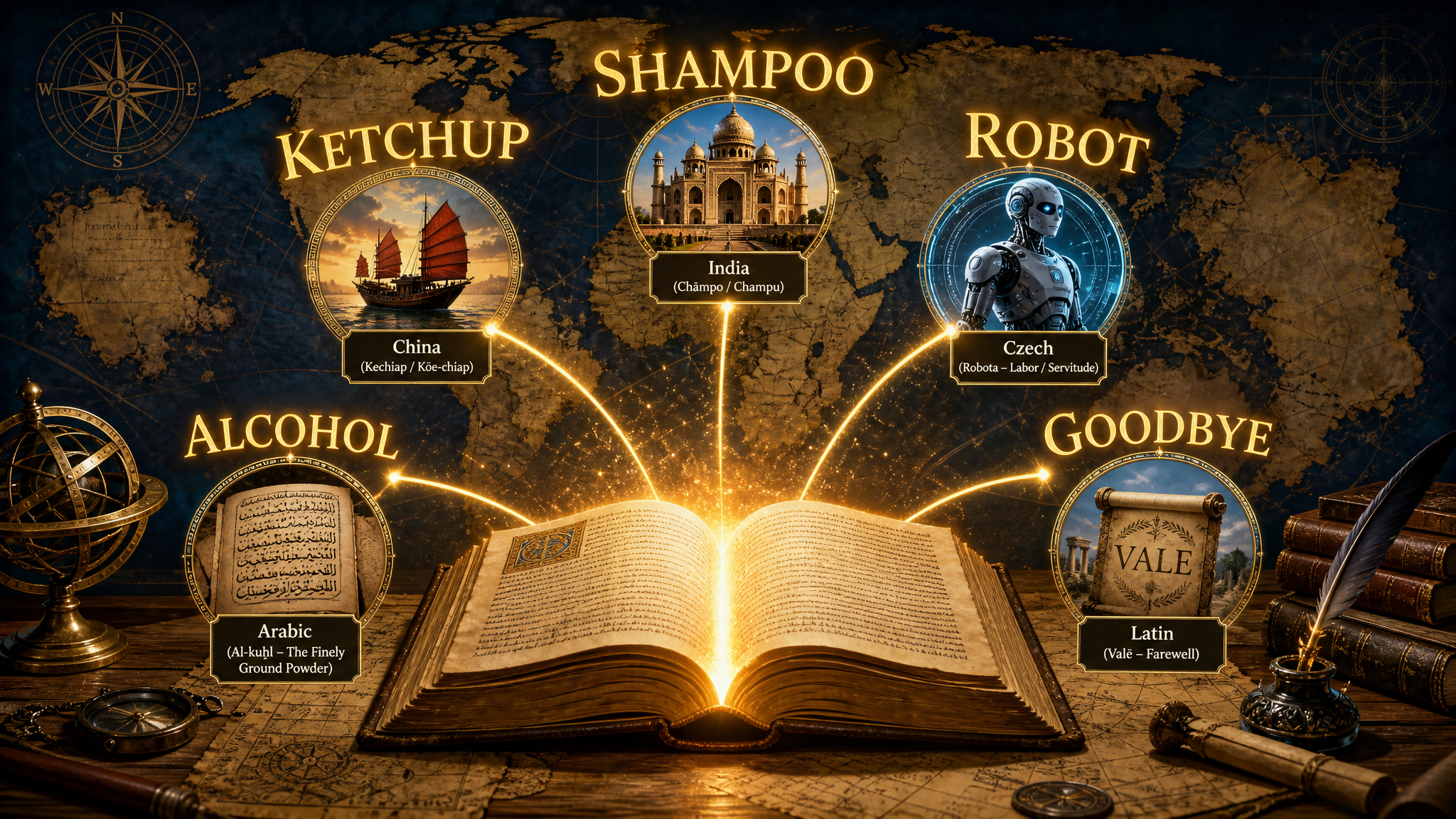
The English language is famous for borrowing words from all over the world. Over centuries, English has absorbed vocabulary from Latin, Greek, French, German, Arabic, Hindi, and dozens of other languages. Some of the most common words we use today have fascinating stories behind them.
1. Shampoo
Most people associate shampoo with modern hair care, but the word actually comes from the Hindi word chāmpo, meaning “to massage” or “to knead.”
British traders and officials in India adopted the term during the colonial period, and it eventually evolved into the word we use today.
2. Ketchup
Believe it or not, ketchup did not originate in America.
The word likely comes from the Hokkien Chinese term kê-tsiap, which referred to a fermented fish sauce. Over time, European traders adapted the recipe, eventually creating the tomato-based condiment we know today.
3. Robot
The word robot comes from the Czech word robota, meaning “forced labor” or “servitude.”
It was first introduced to the world in 1920 by Czech writer Karel Čapek in his play R.U.R. (Rossum’s Universal Robots).
4. Alcohol
Today, alcohol refers to alcoholic drinks and chemical compounds, but the word originally comes from the Arabic term al-kuhl.
It originally referred to a fine powder used as cosmetics around the eyes. The meaning gradually changed through scientific usage before becoming associated with ethanol.
5. Penguin
The origin of penguin remains a mystery.
One theory suggests it comes from the Welsh words pen gwyn, meaning “white head.” Another theory traces it to a Latin-based term meaning “fat.” Linguists still debate its true source.
6. Salary
The word salary comes from the Latin word salarium.
A popular myth claims Roman soldiers were paid in salt. While that is not entirely accurate, salt was extremely valuable in Roman times, and the word’s connection to salt eventually gave us the modern term “salary.”
7. Candidate
The word candidate comes from the Latin candidatus, meaning “clothed in white.”
In Ancient Rome, people running for public office wore bright white togas to symbolize honesty and purity, leading to the term we use today.
8. Nightmare
Originally, a nightmare had nothing to do with bad dreams.
The Old English word mare referred to a mythical evil spirit believed to sit on sleeping people and cause terrifying experiences. Eventually, the word became associated with frightening dreams themselves.
9. Muscle
The word muscle comes from the Latin word musculus, meaning “little mouse.”
Ancient Romans thought that moving muscles under the skin looked like tiny mice scurrying around beneath a blanket.
10. Goodbye
Goodbye originally came from the phrase “God be with ye.”
Over centuries, the phrase was shortened and altered through everyday speech until it became the simple farewell we know today.
Final Thoughts
English is often described as a linguistic sponge because it absorbs words from countless cultures and languages. Every word has a story, and many of those stories are far stranger than most people realize. The next time you use words like shampoo, robot, or goodbye, remember that you’re speaking a small piece of history.


